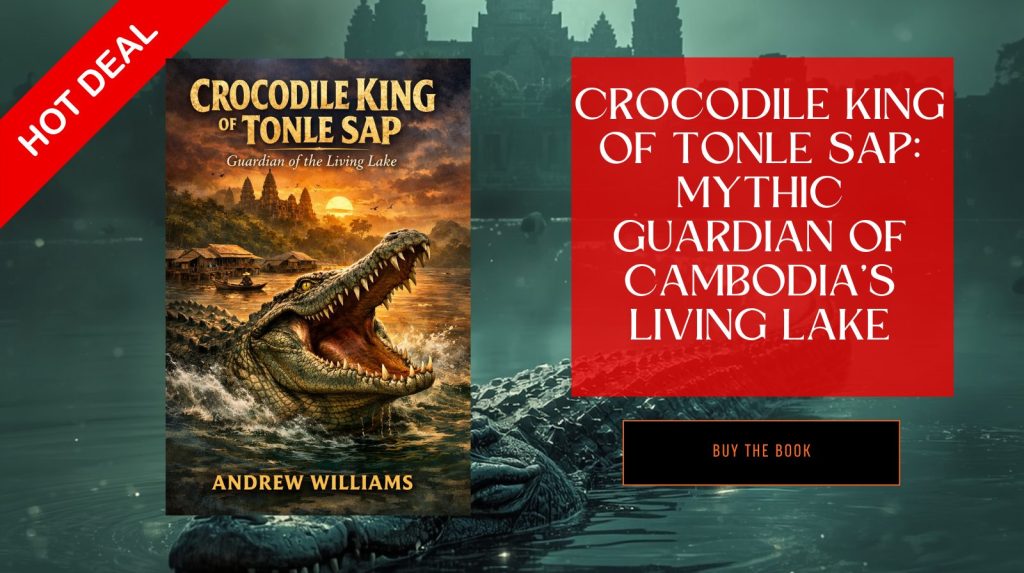
Crocodile King of Tonle Sap: Mythic Guardian of Cambodia’s Living Lake
At dawn on Tonle Sap Lake, the water feels alive.
Fishing boats drift silently through flooded forests, nets cast with practiced rhythm. Beneath the surface, though, locals say something older than memory still moves watching, judging, protecting.
They call it the Crocodile King.
In Khmer folklore, the Crocodile King is no ordinary beast. He is a colossal spirit part animal, part deity who rules the depths of Tonle Sap. Fishermen speak of him in low voices: a guardian who rewards respect with abundance and punishes greed with sudden, unforgiving force.
This is more than myth. On a lake that sustains millions, stories like these shape how people live, fish, and survive.
Origins of the Crocodile King in Khmer Lake Folklore
The legend of the Tonle Sap crocodile king is rooted in Cambodia’s ancient relationship with water.
In traditional Khmer belief, lakes and rivers are not empty they are inhabited by powerful spirits that control balance between life and destruction.
Mythological Origins
| Origin Story | Interpretation |
|---|---|
| Drowned king reborn as crocodile | Divine ruler continuing to protect his people |
| Shaman transformed into guardian | Spiritual mastery over nature |
| Ancient crocodile spirit (yeay krok) | Primordial force tied to water and fertility |
Some versions describe the Crocodile King as a former ruler who sacrificed himself to protect his kingdom from floods. Others portray him as a shaman who gained supernatural powers and merged with the spirit of the lake.
These stories echo early Southeast Asian beliefs from the era of the Funan, when water-based trade and agriculture defined survival.
Carvings in temples around Siem Reap hint at crocodile symbolism, often tied to power, danger, and protection. Local spiritual traditions also intersect with worship at sites like Preah Ang Chek Preah Ang Chorm Shrine, where guardians of land and water are honored.
Tonle Sap Hotspots: Where the Crocodile King Rules the Waters
To understand the Crocodile King, you have to explore his domain.
Tonle Sap is not just a lake it’s a living ecosystem that expands and contracts dramatically with the monsoon, creating one of the richest freshwater environments in the world.
Key Locations Linked to the Legend
| Location | Significance |
|---|---|
| Prek Toal | Core wildlife sanctuary, rumored crocodile habitat |
| Chong Kneas | Gateway for boat tours and fishing communities |
| Kampong Phluk | Flooded forests and seasonal lake expansion |
| Southern Tonle Sap (Pursat) | Remote fishing zones tied to older beliefs |
In villages like Kampong Phluk, homes rise on stilts above seasonal floodwaters. Life here is inseparable from the lake and so are the legends.
Fishermen still leave offerings before heading out, especially during uncertain weather or after hearing of strange occurrences on the water.
Real Encounters: Spotting the Crocodile King’s Kin Today
While the Crocodile King belongs to legend, real crocodiles still inhabit Cambodia’s waterways though they are now rare and protected.
The species most associated with Tonle Sap is the Siamese crocodile, one of the world’s most endangered reptiles.
Wildlife Reality vs. Legend
| Aspect | Reality |
|---|---|
| Crocodile presence | Extremely rare in the wild |
| Habitat | Wetlands and remote lake zones |
| Conservation status | Critically endangered |
| Sightings | Mostly in protected areas |
Eco-tourism initiatives around Prek Toal offer guided experiences where visitors can explore flooded forests and observe wildlife.
Organizations like Wildlife Conservation Society work in the region to protect biodiversity, including crocodile populations and bird species.
Fishermen often share stories of “near misses” nets left untouched or sudden disturbances in the water. These moments are sometimes attributed not to chance, but to the Crocodile King’s unseen influence.
Worshipping the Crocodile King: Rituals on the Living Lake
Belief in the Crocodile King is not passive it is practiced.
Across Tonle Sap’s floating villages, rituals are performed to maintain harmony with the spirit world.
Common Rituals and Offerings
| Ritual | Purpose |
|---|---|
| Chicken or fish offerings | Appease the guardian spirit |
| Rice wine libations | Show respect before fishing |
| Incense burning | Communicate with the spirit |
| Blessing strings | Protection for journeys |
During Bon Om Touk, the connection between water and spirit becomes especially visible. Boat races, ceremonies, and celebrations honor the forces that govern Cambodia’s waterways including legendary beings like the Crocodile King.
Some locals even wear tattoos or amulets representing crocodiles, believing they offer protection and strength.
Legacy of the Crocodile King: Eternal Watch Over Tonle Sap
At its core, the legend of the Crocodile King is about balance.
Tonle Sap is one of the most productive freshwater ecosystems on Earth, supporting millions of people. But it is also fragile threatened by climate change, overfishing, and environmental pressure.
The Crocodile King represents:
- Respect for nature’s power
- The consequences of greed
- The need for harmony between humans and environment
Why the Legend Still Matters
| Theme | Meaning Today |
|---|---|
| Guardian spirit | Encourages sustainable fishing practices |
| Punisher of greed | Warning against overexploitation |
| Protector of life | Symbol of ecological balance |
Tonle Sap is recognized as a UNESCO biosphere reserve, and its preservation is critical not only for Cambodia but for global biodiversity.
For more on conservation and sustainable tourism, resources from organizations like UNESCO and Wildlife Conservation Society offer valuable insights into protecting this unique ecosystem.
The Crocodile King’s Challenge: Respect the Waters
To visit Tonle Sap is to step into a living story.
The lake breathes with the seasons. Villages rise and fall with the water. Life here depends on forces both visible and unseen.
Whether you see the Crocodile King as myth, metaphor, or memory, one thing becomes clear:
The people of Tonle Sap do not take the lake lightly.
And neither should you.
Because somewhere beneath the rippling surface beyond the nets, beyond the reflections Cambodia’s ancient guardian still waits.