

APOPO / Landmine Museum & HeroRAT Center – Discovering Cambodia’s Battle Against Landmines
Just outside Siem Reap, beyond the iconic temples of Angkor, lies one of Cambodia’s most meaningful and thought-provoking sites: the APOPO Landmine Museum & HeroRAT Center. This is not simply a museum it is a living, working hub of humanitarian innovation where education meets action.
Here, visitors gain insight into Cambodia’s devastating landmine legacy while witnessing live demonstrations of landmine detection using trained African giant pouched rats, known as HeroRATs. The experience is deeply human. It is about communities rebuilding their farmland, children growing up safely, and former victims becoming educators and advocates.
For travelers interested in ethical tourism in Siem Reap, this center offers a rare opportunity: to learn, reflect, and directly contribute to Cambodia’s mine action and demining efforts.
The Story Behind APOPO and the Landmine Museum

Cambodia’s Landmine Legacy
Decades of conflict including the civil war and the brutal regime of Pol Pot left Cambodia heavily contaminated with landmines and unexploded ordnance (UXO). Even after the fall of the Khmer Rouge, rural communities continued to face hidden dangers buried beneath rice fields, forests, and village paths.
According to data from the United Nations, Cambodia has made substantial progress in landmine clearance, yet contamination remains a serious challenge in certain provinces. The legacy affects agriculture, infrastructure development, and the safety of children in rural areas.
The Landmine Museum’s Mission
The Landmine Museum was established to educate both locals and international visitors about the history of landmines in Cambodia and to support landmine survivor assistance programs. Its mission goes beyond displaying weapons; it contextualizes the human cost of war and emphasizes resilience, recovery, and prevention.
Introducing APOPO
APOPO is an international non-governmental organization specializing in innovative mine detection. Their groundbreaking work involves training African giant pouched rats to detect the scent of explosives.
The integration of the museum and the HeroRAT Center creates a powerful narrative: from history and trauma to innovation and hope.
What Is the HeroRAT Center?
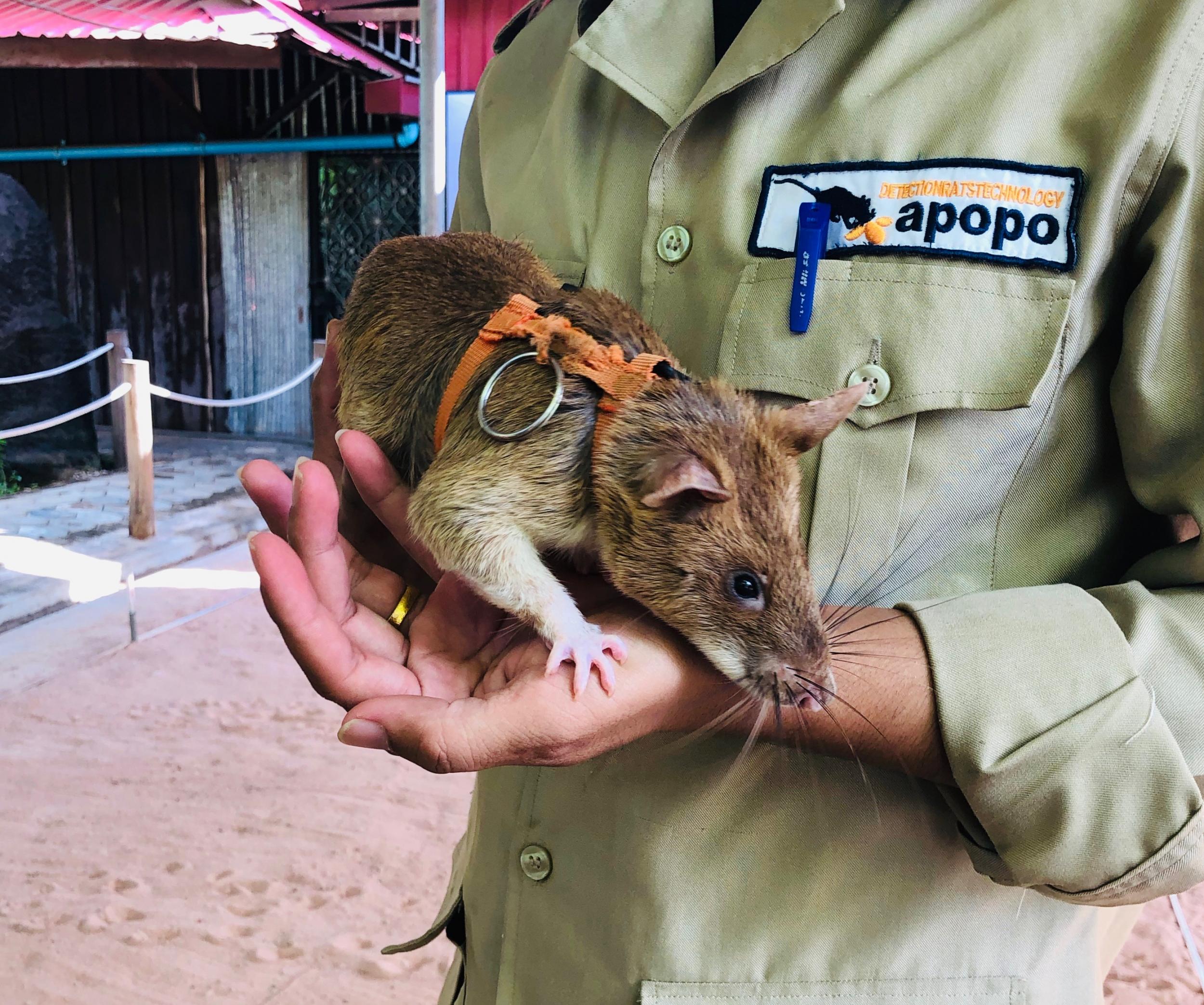
The HeroRAT Center Siem Reap showcases one of the most unique humanitarian technologies in the world.
How HeroRATs Detect Landmines
African giant pouched rats are trained using scent detection techniques to identify explosive compounds such as TNT. Through operant conditioning and reward-based training, rats learn to pause and signal when they detect explosives.
Their sense of smell is highly sensitive, and they can systematically scan a tennis-court-sized area in around 20 minutes far faster than manual deminers using metal detectors.
Why Rats?
From a technical and operational perspective, they are ideal because:
- They are too light to trigger pressure-sensitive landmines.
- They are cost-effective compared to mechanical demining equipment.
- They are highly efficient at distinguishing metal scrap from actual explosives.
The result is faster Cambodian landmine clearance and safer land returned to communities for farming and development.
The Visitor Experience
During your visit, you’ll observe a live HeroRAT training and demonstration session. Staff explain the behavioral science behind the training and the strict safety protocols involved. The demonstration is informative, engaging, and surprisingly uplifting.
Museum Exhibits and What You’ll Learn

The Landmine Museum near Angkor provides layered educational content.
Historical Context
Rooms contain maps detailing contamination zones, collections of deactivated mines, and explanations of different mine types used during Cambodia’s conflicts. Visitors gain clarity on terms like anti-personnel mines, anti-tank mines, and unexploded ordnance.
For deeper background on global mine action standards, organizations like the International Campaign to Ban Landmines provide additional context on international treaties and demining frameworks.
Personal Stories
Perhaps the most powerful sections are the survivor narratives. Profiles of deminers, amputees, and affected families remind visitors that landmines are not abstract geopolitical remnants they are ongoing humanitarian challenges.
Progress and Hope
Educational panels highlight measurable progress in Cambodia mine action and demining. Thousands of hectares have been cleared, schools built, and farmland restored. The message is clear: recovery is possible, but sustained effort is essential.
Visitor Experience: What to Expect on Site
The center’s layout is thoughtfully designed:
- Museum exhibition halls
- HeroRAT outdoor demonstration field
- Memorial and reflection spaces
- Small café and ethical gift shop
A typical visit lasts 1.5–2 hours. You’ll begin with a guided walkthrough of the exhibits, followed by a live rat demonstration. Afterward, visitors often engage staff with questions about demining logistics, survivor support, and future goals.
The atmosphere is emotional yet hopeful. Unlike dark tourism sites that focus on shock value, this center emphasizes resilience, community recovery, and forward-looking solutions.
Ethical Tourism and Your Impact
Visiting APOPO in Cambodia is more than an educational stop it is direct participation in a humanitarian mission.
Entrance fees and donations help fund:
- Active demining operations
- Landmine survivor support in Cambodia
- Community education programs
The gift shop offers responsibly sourced merchandise, with proceeds reinvested into clearance programs.
Responsible tourism practices apply here: ask before photographing staff, be respectful in memorial spaces, and approach exhibits with sensitivity to trauma and loss.
For travelers interested in Siem Reap ethical tourism, this site represents a meaningful alternative to purely recreational activities.
Practical Information for Visiting
- Recommended Duration: 1.5–2 hours
- Best Time to Visit: Morning sessions often align well with scheduled demonstrations
- Location: Approximately 25 minutes from central Siem Reap
Many visitors combine the center with nearby attractions such as Angkor Wat or cultural museums in Siem Reap for a balanced day of historical exploration.
Practical Tips
- Wear comfortable, breathable clothing
- Bring water, especially in hot season
- Prepare for emotionally heavy but highly meaningful content
Summary Table: APOPO / Landmine Museum & HeroRAT Center at a Glance
| Aspect | Details | Why It Matters |
|---|---|---|
| Main Focus | Landmine education & clearance | Understand Cambodia’s recent history |
| Unique Feature | HeroRAT live demonstrations | See innovative demining in action |
| Museum Content | War history, mine types, survivor stories | Human context beyond statistics |
| Visitor Contribution | Tickets, donations, gift shop | Direct support to clearance programs |
| Recommended Duration | 1.5–2 hours | Enough time for tour + demo + reflection |
Conclusion
The APOPO Landmine Museum & HeroRAT Center stands as one of the most impactful places to visit near Siem Reap. It bridges Cambodia’s painful past with practical, science-driven solutions that protect future generations.
In a region world-famous for ancient temples, this site offers something equally profound: a chance to understand Cambodia’s modern history, witness innovation in humanitarian demining, and actively contribute to safer villages and farmland.
For travelers seeking depth, context, and meaningful engagement, including this stop in your Siem Reap itinerary is not just recommended it is essential.


