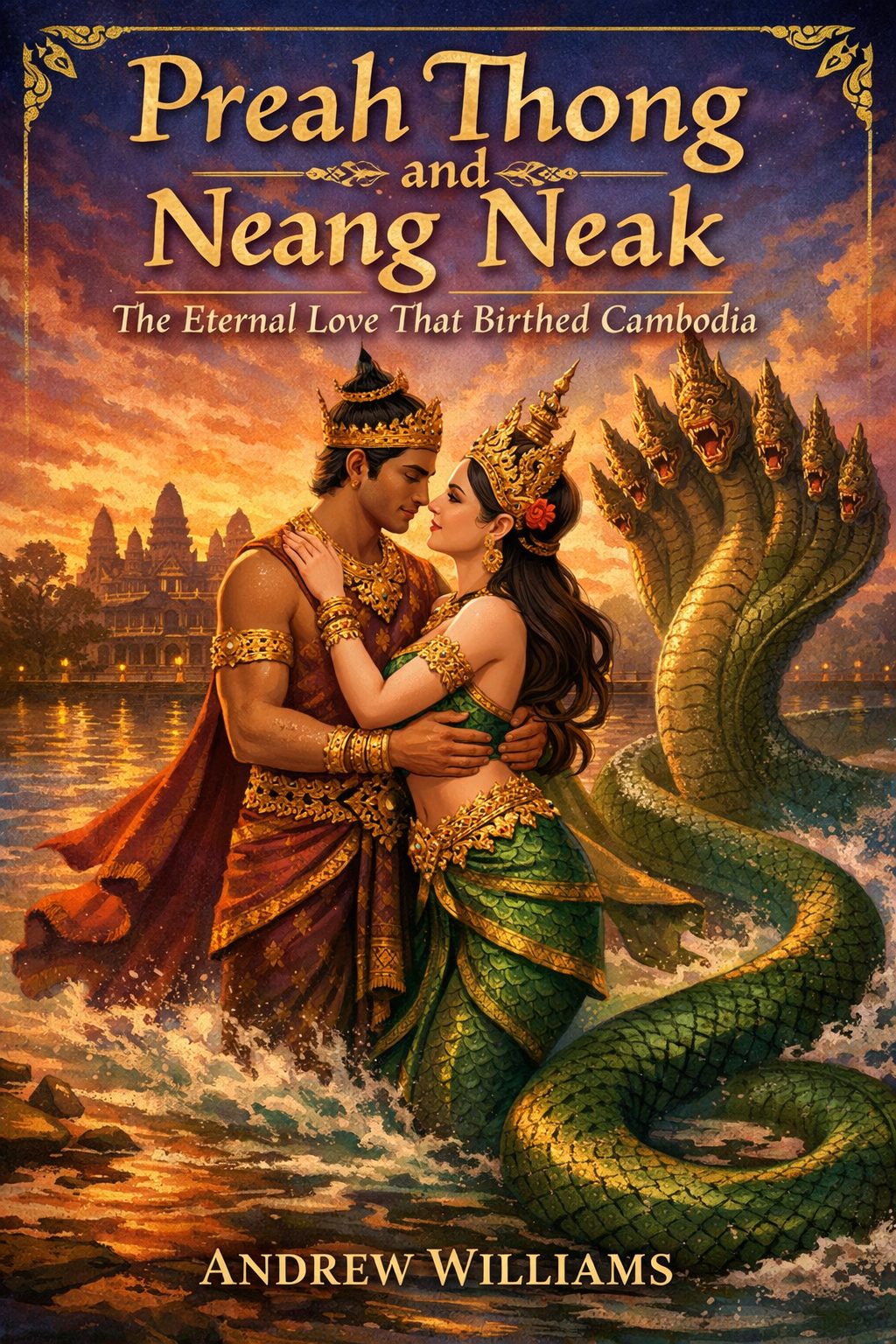
Preah Thong and Neang Neak: The Legendary Love Story That Founded Cambodia
Across Cambodia, from temple carvings to wedding ceremonies, a single myth echoes through centuries of Khmer identity. It is the story of Preah Thong and Neang Neak a tale of love between a wandering prince and a serpent princess that, according to Cambodian tradition, gave birth to the Khmer people.
In this founding myth, romance intertwines with cosmology, migration history, and spiritual symbolism. The story bridges the ancient world of Indian traders and the mystical Naga kingdoms of Southeast Asia, laying a mythical foundation for what would later become one of the region’s greatest civilizations.
Today, the legend still shapes cultural rituals across Cambodia, especially in wedding traditions, temple art, and national identity.

The Timeless Romance of Preah Thong and Neang Neak in Khmer Mythology
According to Cambodian folklore, long before the rise of Angkor’s towering temples, an Indian prince named Preah Thong arrived on the shores of a mysterious island inhabited by serpent beings known as Nagas.
There he encountered Neang Neak, the daughter of the Naga king. Their meeting would spark one of Southeast Asia’s most enduring legends.
The Preah Thong Neang Neak legend tells how their marriage symbolized the union of two worlds:
- The human realm of migrating Indian traders
- The spiritual realm of indigenous Naga guardians
From their union came the Khmer people and the earliest Cambodian kingdoms.
The myth is deeply tied to the ancient Funan civilization, often considered the earliest organized state in the Mekong region. Historians believe this story may reflect real historical interactions between Indian merchants and local Southeast Asian societies.
This blending of myth and history gives the tale its power: it is both a romantic legend and a symbolic explanation for Cambodia’s cultural roots.
Origins of Preah Thong: The Wandering Prince from India’s Chola Lands
The legend begins far from Cambodia, in southern India.
Preah Thong is said to have been the son of a Brahman king from the Chola dynasty. After conflict with his father, he set sail across the ocean, eventually reaching a mysterious island in the region that is now Cambodia.
Storms battered his vessel until he drifted ashore on what local legends call Naga Island.
There, he encountered seven Naga princesses bathing along the shoreline. Among them was the youngest and most beautiful Neang Neak.
According to the story, Preah Thong fell instantly in love.
This moment symbolizes something larger than romance. In Khmer cultural interpretation, Preah Thong represents the arrival of Indian culture, trade networks, and religious ideas into mainland Southeast Asia.
Archaeological discoveries at Oc Eo support the idea that Indian traders reached the Mekong Delta as early as the first century CE, bringing Hindu traditions that later influenced Khmer civilization.
Neang Neak: The Naga Princess Who Sacrificed for Love and Legacy
While Preah Thong represents migration and exploration, Neang Neak embodies Cambodia’s spiritual connection to land and water.
In Khmer mythology, Nagas are sacred serpent beings believed to guard rivers, oceans, and underground kingdoms. They are protectors of fertility, agriculture, and rainfall.
Neang Neak was the daughter of the Naga King who ruled an underwater realm beneath the sea.
When Preah Thong followed her into this kingdom, the Naga King accepted their marriage. As a wedding gift, he performed an extraordinary act.
He commanded the ocean waters to recede.
According to legend, Neang Neak’s hair spread across the sea, creating the fertile lands that would become Cambodia.
The story explains the origins of the Mekong River delta and Cambodia’s rich agricultural plains.
This imagery appears throughout Khmer religious art, particularly in temples such as Angkor Wat, where multi-headed Naga sculptures guard bridges and entrances.
In Cambodian belief, these serpent guardians still protect the nation.
How Preah Thong and Neang Neak’s Union Birthed the Khmer Empire
After their marriage, the Naga King granted the couple a dowry unlike any other.
He drained the surrounding ocean, revealing fertile land where Preah Thong and Neang Neak established their kingdom.
This mythical settlement became the foundation of Funan, the earliest known Khmer state.
Their descendants were believed to rule the region for centuries. Cambodian royal genealogies often trace their symbolic ancestry back to this union.
Later kings of the Khmer Empire including rulers associated with Angkor embraced the legend as part of their divine legitimacy.
Some historians see the myth as a cultural metaphor:
| Myth Element | Historical Interpretation |
|---|---|
| Indian prince Preah Thong | Arrival of Indian traders and Brahman culture |
| Naga princess Neang Neak | Indigenous Southeast Asian societies |
| Draining of the sea | Creation of agricultural settlements in the Mekong delta |
| Royal descendants | Early Khmer rulers of Funan |
In this sense, the story becomes a symbolic record of cultural fusion rather than a literal historical event.
Symbols of Preah Thong and Neang Neak in Cambodian Culture and Art
The Preah Thong and Neang Neak story continues to shape Cambodian traditions today.
One of the clearest examples appears in Khmer wedding ceremonies.
During the ritual, the groom symbolically holds the bride’s scarf and follows behind her mirroring the moment when Preah Thong followed Neang Neak into the Naga kingdom.
This tradition remains a central element of Cambodian weddings across cities like Phnom Penh and rural villages alike.
Cultural Symbols of the Legend
| Cultural Element | Connection to the Legend |
|---|---|
| Khmer wedding rituals | Groom follows bride like Preah Thong followed Neang Neak |
| Naga temple statues | Symbol of protection and royal ancestry |
| Apsara dance performances | Reenact divine and mythological stories |
| Temple bridges | Often shaped like Naga serpents |
Naga imagery dominates the architecture of Angkor Thom, where massive serpent balustrades line the entrance causeways.
You can also find depictions of Naga myths in temples such as Ta Prohm, where bas-reliefs and carvings reflect ancient Khmer cosmology.
The myth even extends into modern culture. Casinos, hotels, and businesses frequently use Naga symbolism as a nod to Cambodia’s legendary origins.
Eternal Lessons from Preah Thong and Neang Neak: Love, Sacrifice, and Nationhood
Beyond mythology, the story of Preah Thong and Neang Neak carries enduring cultural meaning.
It represents:
- Unity between different cultures
- Respect for nature and water
- The importance of family lineage
- The idea that love can create nations
For Cambodians, the legend is more than folklore it is a spiritual narrative explaining how their land and people came into existence.
Stories like this continue to be passed down through traditional storytelling, Buddhist temple teachings, and classical art forms such as shadow puppetry.
Festivals and performances across Cambodia still celebrate the themes of devotion and sacrifice embedded in the myth.
Whether told beside the Mekong River or depicted in the carvings of ancient temples, the legend remains alive.
The love between Preah Thong and Neang Neak endures as a symbol of Cambodia’s origins an epic romance that transformed myth into national identity and shaped the cultural soul of the Khmer world.